How professors grade
A grading rubric can allocate points to issue recognition, rule accuracy and factual analysis, with different weights for each. Georgetown Law’s public exam-writing handout explains that some professors emphasize broad issue coverage while others emphasize nuance. The assigned rubric and instructions determine the balance. Under anonymous grading, identifying information is replaced by the assigned exam identifier; the school’s instructions determine what belongs on the submission.
A grader has a stack of answers and little time. The answer that is easy to score gets the points it deserves. The answer that hides its issues does not.
From the call of the question to an issue plan
The call of the question defines the assignment before the facts suggest possible doctrines. A question confined to damages does not invite a full formation essay. On a first reading, the sequence of events supplies the story. On a second, the legally significant facts supply an issue plan. An attack outline can help with that second task when exam rules permit it; a closed-book exam requires the same distinctions from memory.
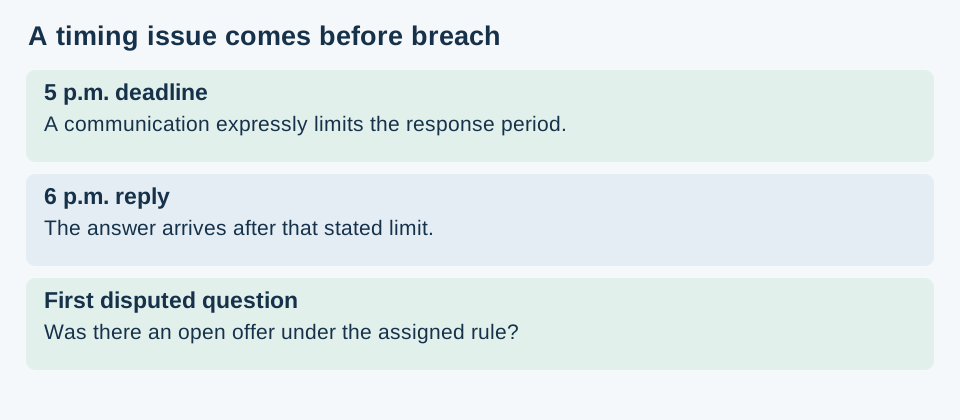
In an original practice problem, an offer expires at 5 p.m. and the recipient sends a reply at 6 p.m. The issue plan has a timing question before any breach question: was an offer still open? A changed fact, such as an express extension, belongs beside that question because it could alter the analysis. Ten minutes of planning in the sample one-hour exercise reserves space for these distinct issues before drafting begins.
How to Write a Law School Exam With IRAC
IRAC stands for Issue, Rule, Application, Conclusion. The issue identifies the dispute; the rule supplies its legal test. Application connects the actual facts to that test, including an exception or competing inference when relevant. The conclusion answers the issue at the level the analysis supports. An element without a supporting fact remains an assertion.
CREAC puts the conclusion first: Conclusion, Rule, Explanation, Application, Conclusion. Some professors prefer it. Check which one yours wants, and use it consistently.
Application: where the points are
Do not say 'the rule is met.' Say which fact meets which element, and why. If the facts cut both ways, argue both and pick one.
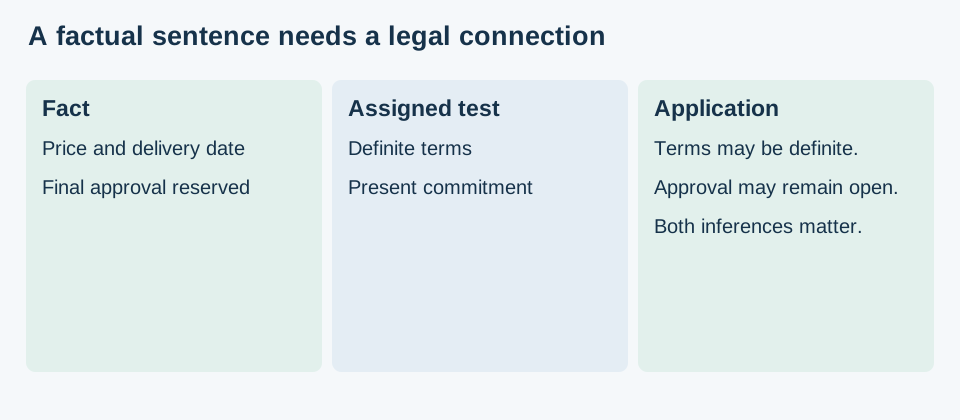
An original exercise might supply a price and a delivery date, but also reserve the sender’s final approval. Under an assigned rule requiring a present commitment, the first two details support definiteness while the reservation cuts against an immediate offer. Merely repeating those details leaves their legal significance unexplained. The application must resolve the competing inferences under the rule the question supplies.
Time budgeting
A stated point allocation gives a starting ratio for the available time. In an original 100-point practice exam, a 40-point question and a 60-point question suggest a 40:60 split before any separate review allowance. An answer confined to the first question leaves sixty available points unaddressed. That arithmetic explains the cost of a detour; it does not guarantee how an incomplete answer will score. Actual instructions, grading weights and any penalties control.
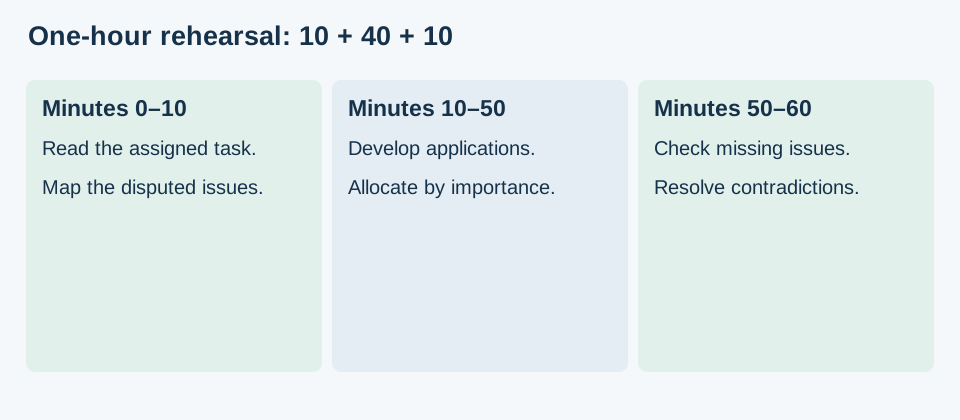
| Minutes | What to do |
|---|---|
| 0 to 10 | Reading and planning: the call of the question, a second factual reading, the issue list and the proposed discussion order. |
| 10 to 50 | Write. Spend more time on the contested issues and less on the easy ones. |
| 50 to 60 | Add missed issues, fix conclusions, and check that every issue on your list is covered. |
Handwritten or typed
Typing permits insertion and rearrangement without fitting additions into handwritten margins. Handwriting requires legible changes and a workable plan for extra paragraphs. The permitted submission mode comes from the exam instructions; typing speed alone does not decide it.
Whichever you use, leave white space between issues. A grader must be able to find each heading at a glance.
Open book, closed book, and take-home
In an open-book exam, the book is not the point. Your own outline is. Tab it by topic and do not rely on looking up rules for the first time.
A take-home exam’s deadline, word limit, citation requirements and permitted materials come from its instructions. A longer window does not remove those limits. Where a legal-memo format and case citations are required, the response needs that organization and the assigned authorities.
The mistakes that cost the most
The first is answering the question you wanted. Answer the one that was asked. The second is a rule without an application. The third is ignoring facts that do not fit your theory, since the professor put them in on purpose.
A twenty-minute discussion of an easy, low-weight issue can consume the time needed for a harder question. The relevant tradeoff is the points and reasoning still available under the actual rubric. More words on a settled element cannot supply an application that is missing somewhere else.
Questions this guide answers
Should an issue-spotting law school essay use IRAC?
IRAC is useful for organizing a disputed issue in an issue-spotting essay. A professor’s required structure controls, and a policy or theory prompt may need a different organization.
How long should a law school exam answer be?
Enough to cover every issue with an application. Length is not the goal. Coverage and fact-specific analysis are.
What can an unfinished law school exam answer still address?
Move on. Outline the remaining issues in brief, with the rule and one sentence of application, so you earn some points on each.
When should a law school exam discuss both sides?
When the facts support both, yes. Say which side is stronger and why, so the grader sees you weighed them.
How does a multiple-choice law school exam differ from an essay?
Yes. Read all four choices, cross out the wrong ones, and watch for an answer that is true but does not answer the question.
Your next steps
- Do a full timed practice exam in each course before finals, not just outline review.
- Grade your own answer against the rubric on the practice exam page.
- Ask your professor for past exams and model answers, and check them against the professor's grading notes.