JD/MBA: the short answer
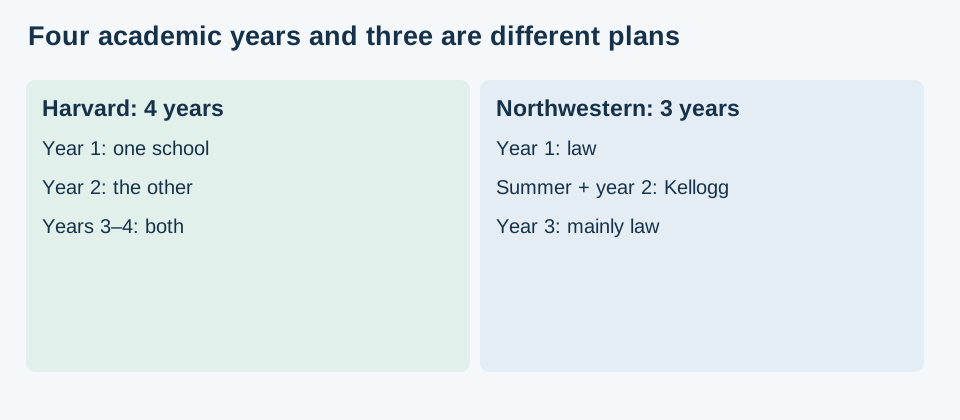
A JD/MBA can reduce the time needed for two separate degrees through a coordinated curriculum and shared credit. The timetable is school-specific. Harvard requires one full year at each school, in either order, followed by two years enrolled in both. Northwestern puts the first year at law school, the first summer and second year at Kellogg, then the final year mainly at law school. Its three-year design includes summer study. The compressed timetable can occupy a summer that a stand-alone JD student might otherwise reserve for work. Program length alone does not reveal that scheduling cost.
How to apply to a JD/MBA
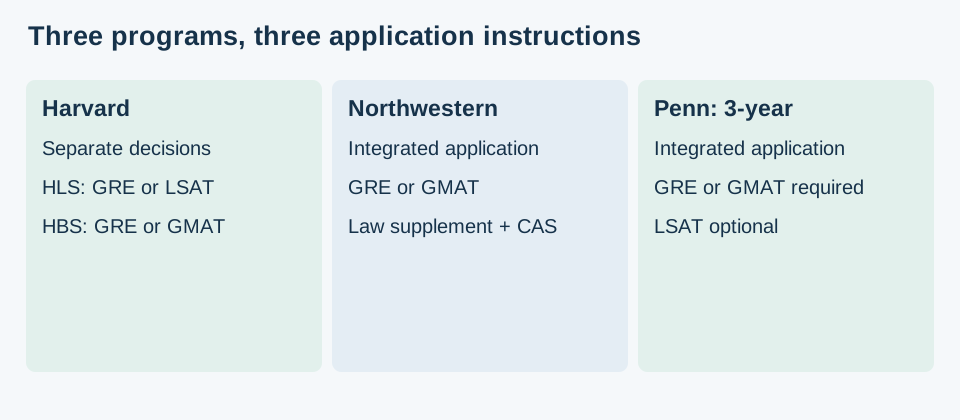
Harvard requires separate admission to HLS and HBS. Its law-school requirements allow the GRE or LSAT under its guidelines, while its business school requires the GMAT or GRE. Northwestern instead uses one integrated Kellogg application, an eligible GMAT or GRE, a law-school supplement and CAS registration; the LSAT and a separate law application are not required. Penn’s three-year Carey JD/MBA also uses an integrated application and a joint decision. Penn requires the GRE or GMAT and makes the LSAT optional. An LSAT score alone does not satisfy that program’s published testing requirement. Ordinary JD admissions rules cannot be substituted for the joint program’s instructions.
- Use the named program’s current application route: Harvard requires separate admissions; Northwestern and Penn’s three-year program use integrated applications.
- Many programs also let you apply to the second school after starting the first; the credit-sharing and timing then differ, so ask.
- Ask each school whether admission to one is conditional on admission to the other.
JD/MBA or just a JD: a way to decide
A JD/MBA is worth considering when the intended work uses both legal and business training, such as a particular transactional, management or development role. That is a proposed use for the education, not a promise of employment or a salary premium. The JD alone avoids the MBA’s additional curriculum and degree requirements; the calendar and price comparison still depend on the actual programs. A joint degree does not replace relevant legal experience. For an undecided student, applying to the second program after starting law school can be an option where that university expressly allows it, as Harvard’s joint-program instructions do.
How the shared-credit structure works
A three-year JD and a two-year MBA would take five academic years if completed consecutively. A coordinated four-year path reduces that calendar comparison through its approved curriculum and shared credit. A three-year joint path can have a different summer workload. Each university sets the credit-sharing arrangement, application sequence and permitted entry points. Both programs must allow the shared credit.
Who the added year and cost actually make sense for
The relevant benefit is a skill or qualification that the intended work actually uses. Potential applications include law and management, health administration or public policy, depending on the second degree. Collecting an additional credential does not establish that an employer will require it or pay more for it. The cost example below deliberately assumes no earnings premium.
Price the fourth year of tuition and one additional year of lost salary against the specific career path the joint degree opens, not against the abstract appeal of holding two degrees.
Credit earned before JD enrollment
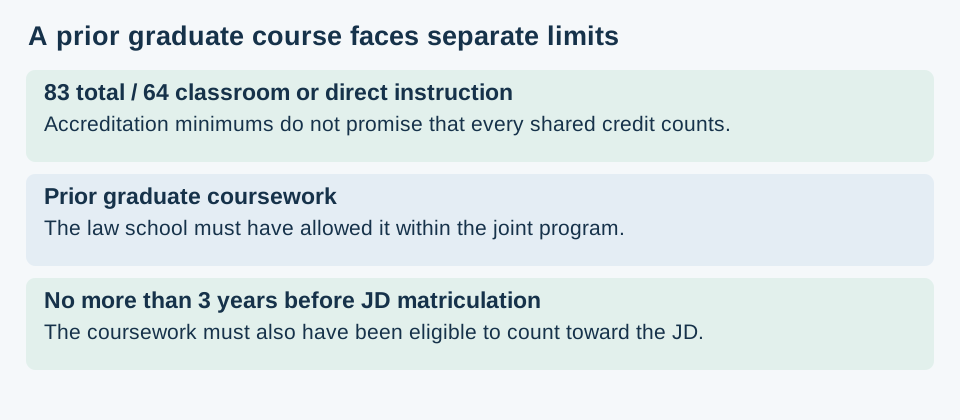
ABA Standard 311 says JD credit generally can be given only for coursework taken after the student matriculated in the JD program, with specified exceptions. Prior law study has separate provisions under Standard 505. The prior-graduate-credit exception for a joint-degree student has its own conditions. Credit earned toward a graduate degree before matriculation counts only under three conditions. The student is in a joint degree program at a law school that would have allowed the credit had it been earned during the joint program. The credit would have counted toward the JD. And it was earned no more than three years before the student matriculated in the JD program.
Interpretation 311-2 permits qualifying non-JD coursework in another university department, school or college, or at another institution. Standard 311 requires at least 83 total JD credits, including at least 64 in the classroom or direct-instruction category. Twelve approved business credits in an original 83-credit curriculum would leave 71 other credits. Whether at least 64 of those qualify requires a separate category check; approval toward the total does not itself answer that question. The law school’s own requirements can be stricter than the accreditation minimum.
Combined programs and admission rules
Standard 313 says a law school may not offer a degree program other than the JD unless four things are true. The school is fully approved. The Council has granted acquiescence. The school has a policy of priority enrollment for JD students in courses required for the degree or the bar. And the program will not interfere with compliance. Acquiescence is not Council approval of the program itself.
Standard 502 lets a school admit an applicant who has completed three-fourths of the credits leading to a bachelor's degree in a combined bachelor's and JD program. Interpretation 503-3 lets a school admit up to 10 percent of an entering class without the LSAT. The students must be same-institution undergraduates or combined-degree students. They must have scored at or above the 85th percentile on the ACT, SAT, GRE or GMAT, as applicable. They must also have ranked in the top 10 percent or held at least a 3.5 GPA through six semesters. Do the math first.
Interpretation 503-3’s limited LSAT exception is not a general ten-percent cap on GRE admissions. Standard 503 and Interpretation 503-1 also address valid and reliable admissions tests other than the LSAT. A school’s particular accepted tests and any applicable variance remain separate questions.
An original budget: distinguish bills from forgone pay
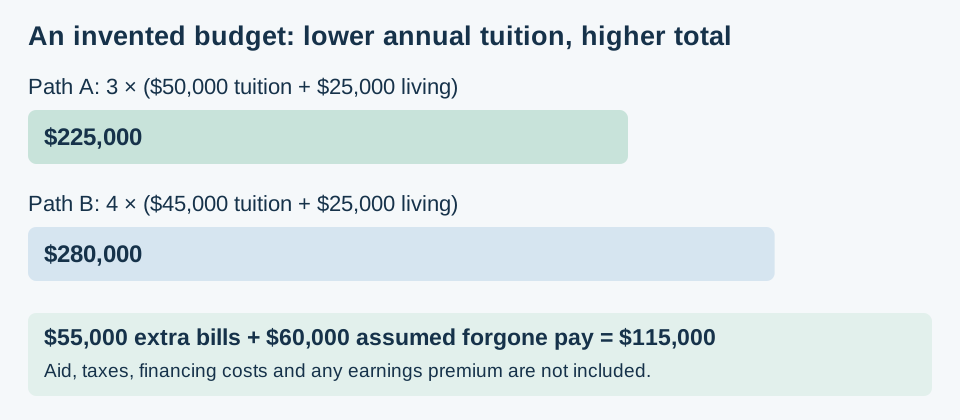
Consider an invented comparison, not a university price quote. Path A has three years at $50,000 annual tuition plus $25,000 annual living costs. Path B has four years at $45,000 tuition plus the same $25,000 living allowance. Path A’s stated education and living bills total $225,000; Path B’s total $280,000. The additional billed cost is $55,000, even though Path B has the lower annual tuition.
Suppose the extra enrolled year would otherwise have produced $60,000 in earnings. Adding that assumed forgone pay makes the difference $115,000 before taxes, aid, interest or changes in salary. No salary premium is assumed for either degree. The comparison cannot prove that the joint degree pays for itself. It identifies the amount that a specific career benefit would have to justify under these invented assumptions.
Credit sharing does not make living expenses disappear. Summer enrollment can also affect a paid-work plan. A usable comparison therefore needs the actual program calendar and aid terms alongside its tuition figure; the calculation above keeps those variables visible instead of turning a program’s advertised duration into a complete cost estimate.
Questions this guide answers
Can a Penn Carey Law JD/MBA applicant also apply to the standalone JD?
Penn’s joint-program FAQ prohibits applying to the dual degree and to either standalone JD or MBA in the same admissions cycle. Round 2 is not a fallback. A denied joint application does not open a standalone route later in that cycle.
Can a Penn Carey Law 2L use the three-year JD/MBA route?
Penn’s current-student instructions allow its 2Ls to apply only to the four-year program. Its 1Ls may apply to the three-year or four-year version. The applicant’s current enrollment stage therefore affects which timetable is available.
Who handles financial aid for Harvard’s law school JD/MBA?
Harvard Law School processes aid for the law-only year and year four. Harvard Business School handles the business-only year and year three. That division applies whichever school the student attends first; a combined curriculum does not mean one office processes every year.
Does ABA acquiescence give a non-JD law-school degree federal loan access?
Acquiescence alone does not establish Title IV loan access. Interpretation 313-1 requires national accreditation of the law school or its affiliated university for that purpose and distinguishes acquiescence from program approval. Eligibility for a particular program or student remains a separate question.
Your next steps
- Confirm the exact credit-sharing structure and total program length at each target school.
- Apply to both programs on the timeline each one specifically requires: they're often separate applications.
- Identify the specific role or career path the joint degree is meant to open before committing.
- Price one extra year of tuition and lost salary against that specific path's realistic return.