Deciding between the LSAT and the GRE
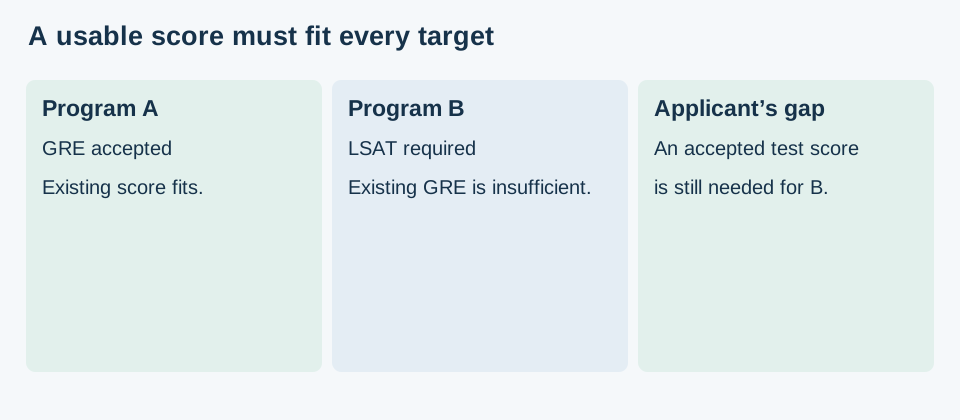
Policy varies by school. Check every target school's current admissions page individually. GRE acceptance varies by school and can change from cycle to cycle, and a school's acceptance of the GRE does not guarantee equal weight in its admissions index. If even one target school requires the LSAT specifically, that requirement should usually control your decision.
Candidates already holding a strong, recent GRE score, or those applying to a broader mix of graduate programs alongside law school, are the clearest fit for the GRE route. A candidate applying only to law school with no existing GRE score has less reason to add a second test instead of preparing directly for the LSAT.
How LSAT accommodations actually work
Accommodations requests go through LSAC directly, not through your undergraduate or current school's disability office, and require current documentation meeting LSAC's own standards: a school's accommodation letter alone is not automatically sufficient. Build in time for the request and any follow-up documentation well before your registration deadline.
Analytical Reasoning (Logic Games) left the LSAT in August 2024 following the disability-rights settlement. Test format and accommodation eligibility are separate questions. For the 2026-2027 cycle, LSAC generally uses in-center testing; certain disability-related accommodations can require a remote administration. An accommodation approval therefore needs to be read for its actual delivery conditions, not treated as a general exemption from the in-center policy.
What the sources say about GRE acceptance
ETS's October 4, 2022 release said 100 of the 199 ABA-accredited law schools then accepted the GRE for admission, and that the American Bar Association's November 2021 decision confirmed the use of the GRE in law school admissions in lieu of the LSAT. That is a dated count, not a current one, so use ETS's own list of law schools accepting GRE scores for JD programs, and confirm each school's policy on its admissions page.
ETS's list is not uniform: at least one entry carries a note that the GRE is accepted for select students only, and ETS says many listed schools also consider GRE scores when awarding scholarships. LSAC's fee page lists the LSAT at $253, including LSAT Argumentative Writing, for the August 2026 to June 2027 testing year.
What LSAC's accommodations process requires
LSAC says registered test takers submit accommodation requests through JD Services, with all supporting documentation, by the accommodation request deadline, which is always the same as the test registration deadline. It says there are no exceptions to that deadline, that requests submitted late will not be considered, and that it does not return or copy documentation, so you should keep your own copies. Decisions are posted as a letter in JD Services, typically within two weeks according to LSAC's remote-testing page.
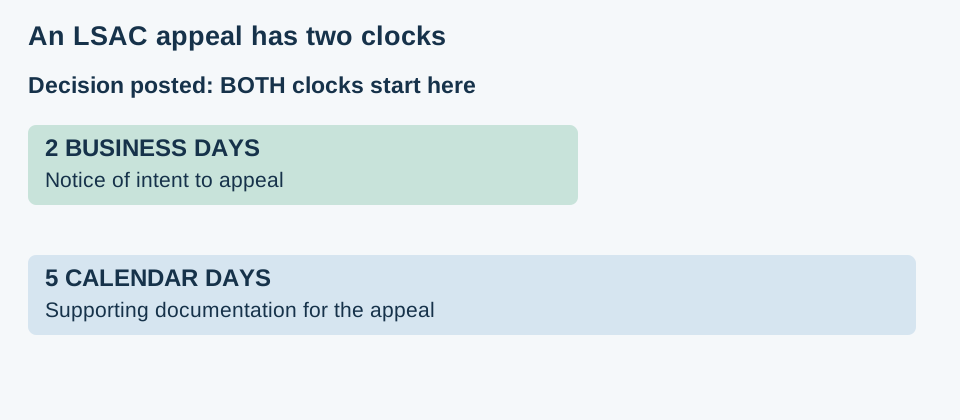
LSAC’s appeal procedure covers disability-related denials, excluding denials for lateness or missing registration. Both deadlines run from the posting of the decision to the online account: two business days for notice of an intent to appeal and five calendar days for supporting documentation. The second period does not begin after the first. LSAC states a result within one week after appeal submission, barring unforeseen circumstances. For an appeal received after five calendar days, its procedure permits a requested move to the next administration at no added cost so the appeal can be considered. LSAC generally carries forward the same or substantially similar accommodations from the last LSAT registration under its prior-approval policy. Its stated exceptions include temporary conditions, paper-format or modality rules, and situations in which records of an approval more than five years earlier are unavailable. Different or additional accommodations require a timely supported request.
Which accommodations LSAC lists, and who may still test remotely
LSAC's non-exhaustive list includes assistive technology such as JAWS, ZoomText and Dragon at Prometric centers, extended testing time, additional breaks between multiple-choice sections, stop/start breaks of up to 60 minutes, braille equipment, tactile manipulatives, a human reader and a scribe. It says the combination of testing time and breaks for the multiple-choice LSAT may not exceed eight hours in one day, and testing over two days is administratively approved if the combination would exceed it.
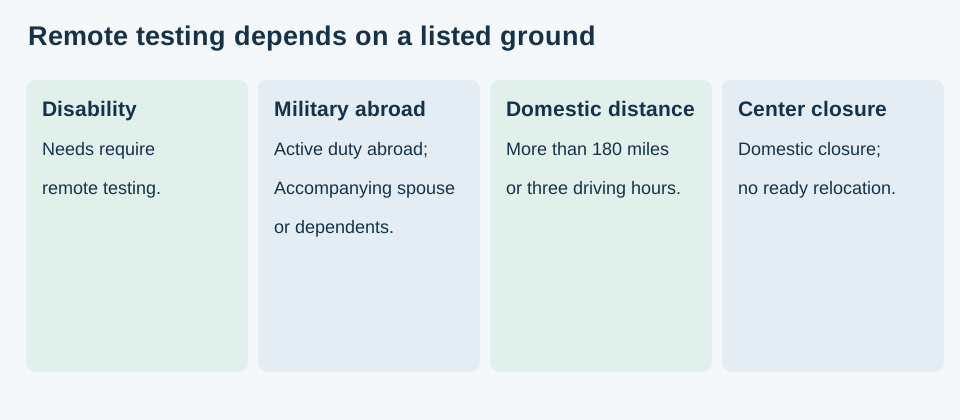
Starting with the August 2026 LSAT, LSAC says the multiple-choice portion is moving toward in-center testing for almost all test takers. Remote exceptions it will consider for 2026-2027 are certain disability-related accommodations that require remote testing, active-duty military stationed abroad and their accompanying spouses and dependents, test takers more than 180 miles or three hours' driving from a center with available capacity, and test takers whose domestic center closes for weather or unforeseen reasons. Approved remote test takers must use a smartphone as a second camera. LSAC does not annotate accommodated score reports and does not tell law schools a candidate requested accommodations.
An original application audit: two independent gaps
Suppose an applicant’s chosen program requires an LSAT score, and the applicant also needs a disability-related testing adjustment. A strong GRE score answers neither missing item in this stipulated problem. The program’s test rule determines the score gap; the provider’s accommodation policy determines the adjustment procedure. Treating one as a substitute for the other would leave the plan incomplete.
Now change only the program’s stated policy so that it accepts the applicant’s existing GRE score. That change can remove the hypothetical admissions-score gap. It does not transfer an LSAT accommodation to a GRE administration, establish a remote-testing exception or change any provider deadline. The point of the comparison is to identify which decision each new fact actually affects.
Questions this guide answers
Do LSAT stop/start breaks extend testing time?
No. LSAC says the clock pauses and restarts without a loss or gain of testing time. A stop/start break is a break allowance, not extra scored minutes.
Which medical items need an LSAT accommodation?
LSAC lists medication and hearing aids among personal medical items allowed without a request. Bluetooth-enabled medical devices still require preapproval as a testing accommodation. The published permitted-items rules govern the particular item.
Can I automatically restore an LSAT accommodation after opting out?
No. LSAC treats an opt-out as final for the current registration and future administrations. A candidate who later wants that accommodation again must make a new request by the applicable deadline.
Is scratch paper allowed for LSAT Argumentative Writing?
Paper scratch sheets are not generally permitted. The writing interface includes digital scratch space. Paper requires a requested and approved testing accommodation under LSAC’s published format policy.
Your next steps
- Confirm each target school's current GRE-acceptance policy on its own admissions page, not a third-party list.
- Start an accommodations request early, with current documentation meeting LSAC's own stated standard.
- Don't assume a prior school's accommodation letter transfers automatically to LSAC.
- If accommodated, confirm your specific test date's delivery format directly with LSAC.